
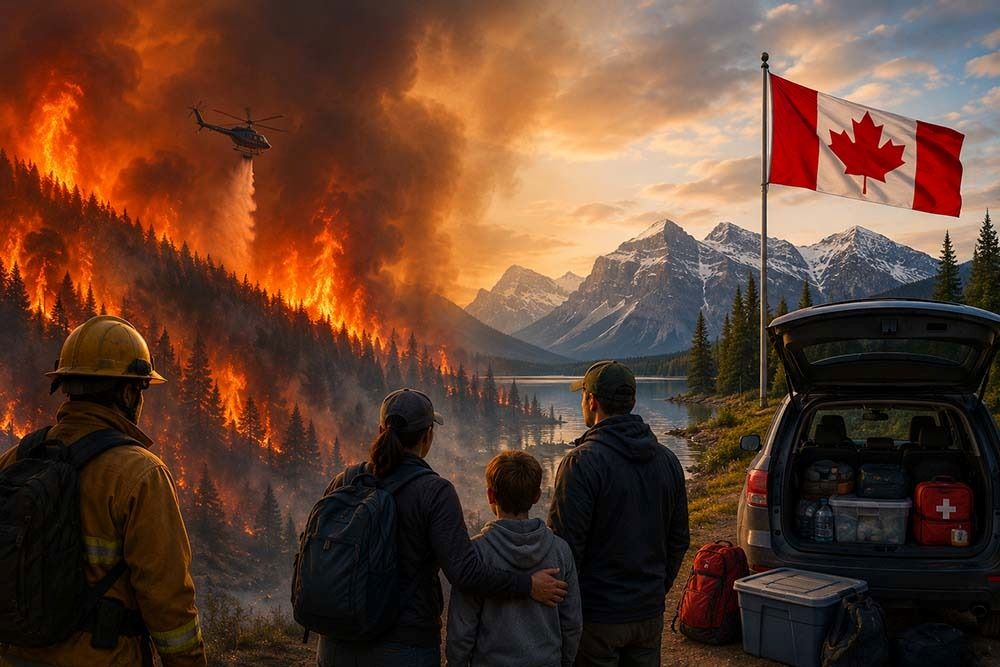
Canada entered 2026 watching heat, drought, smoke, and alerts. The Canada wildfire season 2026 is already active, but the national picture is not identical everywhere. Federal officials reported 3,137 fires and 1.4 million hectares burned by July 9, although 2025 had burned more land by then.
The latest Canada wildfires 2026 outlook shows regional differences. Above-average temperatures are forecast across much of the country through July and August, while dry conditions are expected in Manitoba and northwestern Ontario.
Where Is Wildfire Danger Highest?
Federal modelling for July indicates the highest fire danger across the Northwest Territories, Nunavut, northern Manitoba, and areas surrounding Hudson Bay. Northern Ontario and Quebec also face elevated fire potential.
The Canada wildfires 2026 outlook currently suggests lower to moderate danger across much of western Canada after widespread precipitation, although localized areas of interior British Columbia remain concerning. In August, southern interior British Columbia is expected to face higher-than-normal danger.
That means the Canada wildfire season 2026 cannot be summarized as one nationwide prediction. Conditions can change rapidly with rainfall, lightning, wind, temperature, and available forest fuels. Canadians should follow provincial and territorial fire agencies for local information.
How Canadians Are Preparing Differently
Recent destructive seasons have made emergency planning more familiar. How Canadians are preparing for wildfires 2026 includes emergency plans, monitoring alerts, preparing medications, and planning for vulnerable household members.
Residents in wildfire-prone communities are also encouraged to understand evacuation routes and reduce hazards around properties where appropriate. A wildfire evacuation guide for Canada 2026 should begin before smoke or flames are visible.
Families should decide how they will communicate if separated and identify accommodation. Keeping vehicles reasonably fuelled and charging phones during elevated risk periods improves readiness.
What Belongs in a Wildfire Go-Bag?
An emergency kit should support household needs for at least 72 hours. Practical items include water, non-perishable food, medications, identification copies, important contact information, phone chargers, flashlights, batteries, a radio, cash, basic first-aid supplies, and seasonally appropriate clothing.
A wildfire evacuation guide Canada 2026 should also consider infants, older adults, disabilities, and pets. Prescription medications and necessary medical supplies deserve particular attention.
How Canadians are preparing for wildfires 2026 increasingly includes smoke supplies. Health Canada recommends having well-fitting NIOSH-certified N95 or equivalent respirators available when outdoor exposure cannot be avoided.
How Wildfire Smoke Affects Indoor Air
Wildfire smoke contains fine particles that can enter buildings through doors, windows, ventilation, and small gaps. Even communities far from active fires may experience unhealthy air as smoke travels across provinces or international borders.
During the Canada wildfire season 2026, residents should monitor the Air Quality Health Index or Quebec’s InfoSmog system. Health Canada recommends keeping windows and doors closed as much as possible during smoke events and using the highest-quality ventilation filter a system can safely handle.
Properly sized portable air cleaners can help filter fine particles. Extra replacement filters are useful during prolonged smoke. The Canada wildfires 2026 outlook makes smoke preparation relevant even for households in areas with relatively low direct wildfire danger.
Preparing Without Trying to Predict Everything
Wildfire behaviour is difficult to predict precisely. Forecasts identify broad patterns, but individual fires depend on changing weather and local conditions.
How Canadians are preparing for wildfires 2026 should therefore focus on readiness rather than guessing whether a particular neighbourhood will evacuate. Monitor official alerts, maintain an emergency kit, know evacuation routes, and follow local instructions.
A practical wildfire evacuation guide Canada 2026 should be reviewed with every household member. Preparation alone cannot eliminate wildfire risk, but it can significantly reduce confusion when urgent decisions must be made quickly.
FAQ’s
Q1. How bad is the 2026 wildfire season predicted to be in Canada?
A: Federal forecasts indicate above-average temperatures across much of Canada, with regional fire danger varying. As of July 9, Canada had recorded 3,137 fires and 1.4 million hectares burned. Officials continue monitoring changing weather and fuel conditions.
Q2. Which Canadian provinces face the highest wildfire risk in 2026?
A: Current July modelling highlights northern Manitoba and elevated potential in northern Ontario and Quebec, while northern territories also face high danger. Southern interior British Columbia is expected to see higher-than-normal danger in August. Conditions can change.
Q3. What should Canadians have in an emergency go-bag for wildfire evacuation?
A: Pack water, food, medications, identification copies, contact details, chargers, flashlights, batteries, radio, cash, first-aid supplies, and clothing. Include items for children, pets, older adults, or medical needs. N95 or equivalent respirators can help during smoke exposure.
Q4. How does wildfire smoke affect indoor air quality across Canada?
A: Fine smoke particles can enter homes and reduce indoor air quality, even far from fires. Close windows and doors during smoke events, monitor air quality, maintain ventilation filters, and consider a properly sized portable air cleaner.